Official Rules
The Eldiron Official Ruleset is the default fantasy RPG ruleset bundled with Eldiron. It gives characters, races, classes, weapons, armor, spells, progression, visuals, and world simulation one shared meaning.
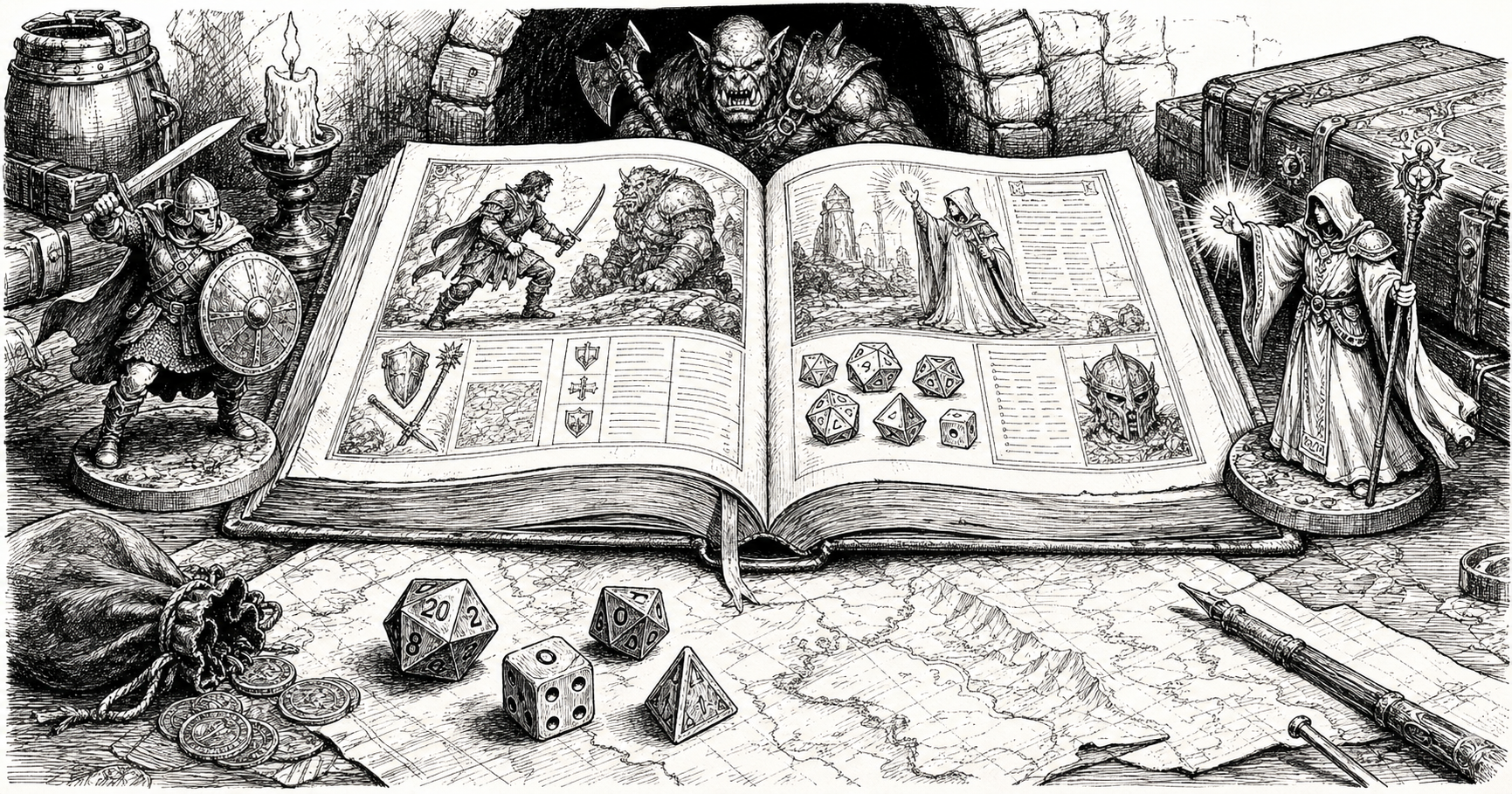
This is a preview of the official ruleset direction for the next release line. It is not the final v1 scope. Version 1 is expected to grow beyond the current draft with more classes, races, spells, equipment, crafting, conditions, loot, encounter tools, localization, and balancing support.
One Rulebook For The World
A Warrior, an Orc, a training sword, a healing spell, and a leather vest should all mean something before a project author writes custom behavior graphs. The official ruleset is that shared meaning.
How To Read The Rules
The official ruleset is a tabletop-style rulebook backed by nodes. The guide explains how the rules play. Edit the definitions through Game / Rules; see Ruleset Nodes for the authoring workflow. Creator, clients, runtime systems, and tools share the compiled rules.
TOML examples on this page describe the compiled fields for reference. Author these fields as typed rows and connected nodes in Creator.
| Rulebook term | Compiled field | Used by |
|---|---|---|
| Race | [races.Human], [races.Orc] | identity, relations, visual defaults |
| Class | [classes.Warrior] | stats, equipment, abilities, loadouts |
| Weapon | [items.weapons.training_sword] | damage, cooldown, range, visuals |
| Spell | [spells.minor_heal] | cost, range, cast time, effect |
| Intent | [intents.attack] | allowed actions and distances |
| Icon | [icons.basic_attack] | bundled artist-editable RGBA artwork and attribution |
| Combat kind | [combat.kinds.fire] | damage bonuses and reductions |
The bundled eldiron.official ruleset is authored in rules.graph.json.
Each project owns a complete editable copy and preserves its original for recovery.
Ruleset timing values are measured in seconds. Cooldowns, spell durations, FX
durations, resource respawns, corpse lifetimes, and NPC respawn delays all use
seconds so combat and abilities remain easy to tune. Script scheduling commands
such as notify_in and block_events are different: they use in-game minutes
because they schedule world-clock events.
| Field | Current value |
|---|---|
| Ruleset id | eldiron.official |
| Name | Eldiron Official Ruleset |
| Version | 1.0.0 |
| Schema version | 1 |
| Engine minimum | 0.91.0 |
| Status | draft |
Dice
Eldiron uses dice notation for readable random values.
Roll one six-sided die. Result: 1 to 6.
Roll one eight-sided die. Result: 1 to 8.
Used for critical checks and future resolution rules.
A ruleset damage entry is intentionally readable:
[items.weapons.training_sword.damage]
roll = "1d6"
bonus = 1
bonus_attribute = "STR"
bonus_every = 4
damage_kind = "physical"
Read it as:
- Roll
1d6. - Add the flat
bonus. - Add one more bonus for every 4 points in
STR. - Treat the result as
physicaldamage.
So a Warrior with STR = 12 using a training sword rolls 1d6, adds 1, and
then gains 3 more from Strength.
The fields stay explicit. Tools can explain it, calculate it, and test it without requiring hidden formulas in character data.
Character Sheet
Every character starts from shared attributes. Race and class then shape those attributes into a playable role.
| Group | Attributes |
|---|---|
| Primary | STR, DEX, INT, WIS, VIT |
| Resources | HP, MAX_HP, MP, MAX_MP |
| Combat | DMG, POWER, ARMOR, RESIST, FIRE_RESIST, INIT, SPEED |
| Progression | LEVEL, EXP |
| Attribute | Meaning |
|---|---|
STR | physical force, melee scaling, carrying future heavy actions |
DEX | agility, initiative, future ranged and avoidance hooks |
INT | arcane spell scaling and knowledge hooks |
WIS | divine spell scaling, resolve, and perception hooks |
VIT | toughness and health scaling |
HP / MAX_HP | current and maximum health |
MP / MAX_MP | current and maximum mana; MP regenerates over time |
ARMOR | physical protection |
RESIST | general magical protection |
FIRE_RESIST | fire-specific protection |
POWER | general spell power |
The official ruleset maps semantic runtime roles explicitly:
[attributes.roles]
health = "HP"
max_health = "MAX_HP"
level = "LEVEL"
experience = "EXP"
weapon_damage = "DMG"
armor = "ARMOR"
These names are official content, not engine constants. Standalone rulesets can
map the same roles to different attributes or omit progression roles entirely.
Spell and ability costs are typed action maps, so the official MP costs use
the same runtime path as a custom FOCUS, stamina, or ammunition resource.
Derived stats are calculated on demand from the ruleset. The saved character
attribute remains the base, while the formula may reference level, another
attribute, or another derived stat:
[derived_stats.POWER]
formula = "base + floor(max(0, INT - 10) / 4) + floor(max(0, WIS - 10) / 4)"
minimum = 0
The official rules define MAX_HP, MAX_MP, DMG, POWER, INIT, and
SPEED this way. Derived values drive combat, action requirements, healing,
resource caps and regeneration, and respawn health. Condition modifiers apply
to formula inputs and then to the resulting stat, without overwriting saved
base attributes.
Mana regeneration is configured by [resource_regen.MP] in the official
ruleset. The default restores 1 MP every 3 real-time seconds while the
character is active, capped by MAX_MP.
Class resource growth uses progression.level.resource_gains. Each entry names
its current attribute, maximum attribute, and amount gained per level. Cleric,
for example, grows both HP and MP; Warrior and Ranger grow HP. The same generic
list supports custom resources and levels 11–30 without additional field types.
Races
Races provide identity, language, visual defaults, attribute defaults, and base relations.
| Race | Role | Avatar | Languages | Key defaults |
|---|---|---|---|---|
Human | balanced default people | humanoid | common | HP 10, all primary attributes 10 |
Orc | strong hostile test race | orc | orcish | HP 14, STR 12, DEX 9, INT 8, WIS 8, VIT 12 |
Skeleton | undead skeletal creature | skeleton | - | HP 12, VIT 12, traits undead, skeletal |
Race names are not hardcoded factions. They are identity defaults that feed relations and reputation. Race traits are materialized as normal entity attributes, so custom actions can inspect them through the same public predicate system.
The bundled skeleton.eldiron_avatar currently copies the humanoid frames but
has its own asset id, internal UUID, and name. It is an editable placeholder:
importing a dedicated Skeleton atlas replaces its art without changing race or
project references.
Disposition And Reputation
Disposition answers a practical AI question: should this character treat that character as friendly, neutral, or hostile?
| From / Toward | Human | Orc | Skeleton |
|---|---|---|---|
| Human | friendly | hostile | hostile |
| Orc | hostile | friendly | hostile |
| Skeleton | hostile | hostile | friendly |
Reputation starts at 0, which means the race relation is used as-is.
| Reputation | Disposition |
|---|---|
-50 or lower | hostile |
0 | normal relation |
50 or higher | friendly |
Scripts should use is_hostile(entity_id) or disposition_of(entity_id) when
they need an AI decision. They should not inspect custom alignment numbers.
Classes
Classes are the main playable role definitions. A class controls attributes, equipment permissions, abilities, spells, progression hooks, and starting loadout.
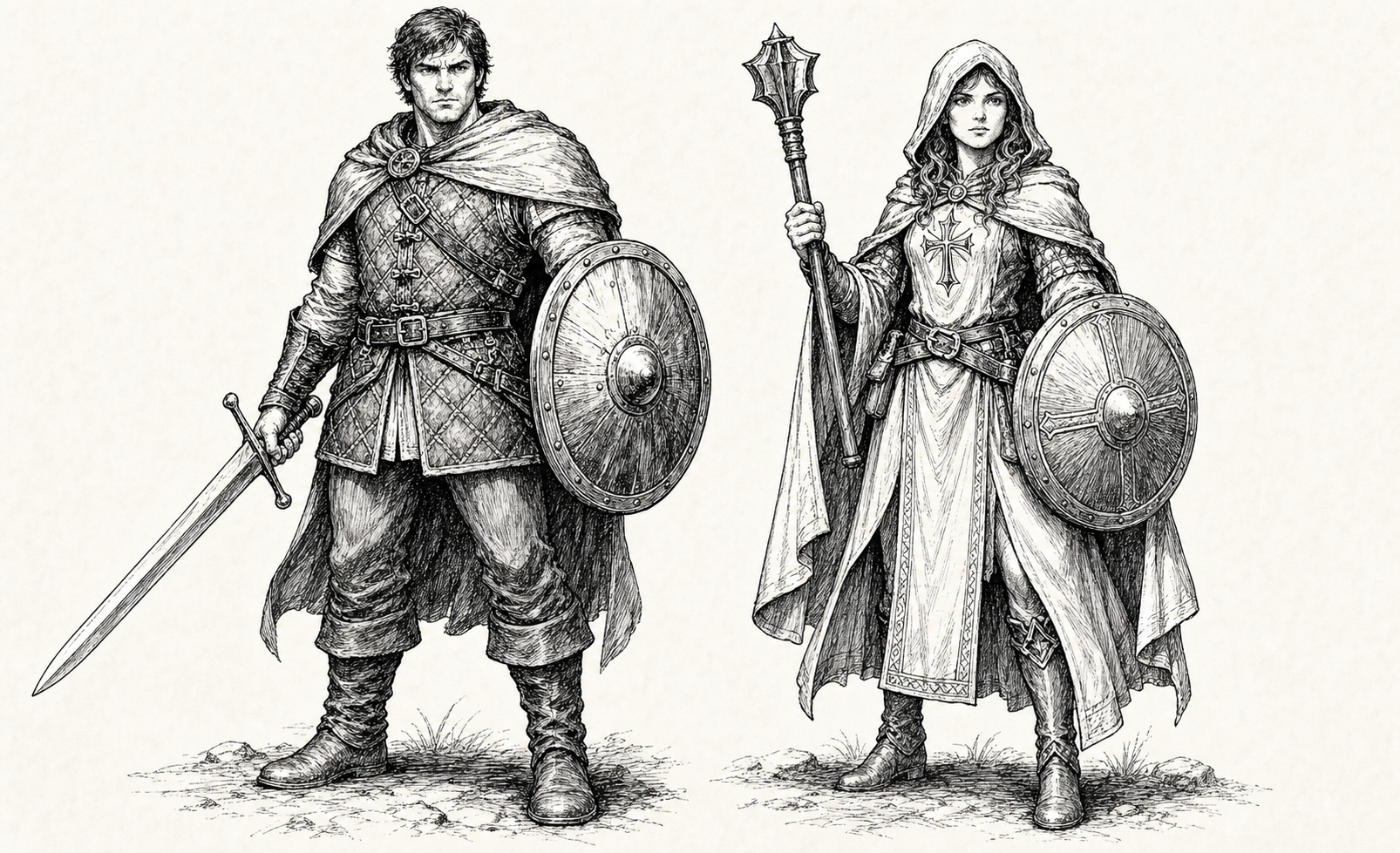
Warrior
Durable weapon user. Strong opening class for melee, armor, shields, and basic combat tests.
- Primary: STR, VIT
- HP 16 / 16
- Training Sword
- Padded Armor
Cleric
Armored support caster. Establishes mana, healing, spell unlocks, and divine scaling.
- Primary: WIS, VIT
- HP 14 / 14, MP 8 / 8
- Novice Mace
- Minor Heal
Ranger
Mobile hunter. Establishes ranged weapon range, bow damage, ammunition, and DEX scaling.
- Primary: DEX, VIT
- HP 14 / 14
- Hunting Bow
- Wooden Arrows
Citizen
Settlement baseline for vendors, crafters, trainers, and other non-adventuring NPCs.
- Primary: VIT
- HP 10 / 10
- No combat abilities
- Profession services
Warrior
| Area | Rule |
|---|---|
| Role | martial |
| Primary attributes | STR, VIT |
| Weapons | sword, axe, mace, spear, bow |
| Armor | cloth, leather, chain, shield |
| Starting health | HP 16, MAX_HP 16 |
| Starter money | 5s |
| Starter weapon | training_sword |
| Starter armor | padded_armor |
| Starter clothing | wool_trousers, leather_shoes |
| Starter inventory | none |
| Level 1 abilities | basic_attack, guard |
| Level 2 unlock | power_strike |
| Level 4 unlock | rally |
| Level 6 unlock | crushing_blow |
| Level 8 unlock | iron_guard |
| Level 10 unlock | executioner_strike |
Cleric
| Area | Rule |
|---|---|
| Role | divine |
| Primary attributes | WIS, VIT |
| Weapons | mace |
| Armor | cloth, leather, chain, shield |
| Starting health | HP 14, MAX_HP 14 |
| Starting mana | MP 8, MAX_MP 8 |
| Starter money | 5s |
| Starter weapon | novice_mace |
| Starter armor | cleric_vestments, round_shield |
| Starter clothing | wool_trousers, leather_shoes |
| Starter inventory | blessed_herb, moonwater |
| Level 1 abilities | basic_attack, guard |
| Level 1 spells | minor_heal |
| Level 2 unlock | holy_light |
| Level 4 unlock | blessing, turn_undead |
| Level 6 unlock | greater_heal |
| Level 8 unlock | smite |
| Level 10 unlock | sanctuary |
Ranger
| Area | Rule |
|---|---|
| Role | ranged |
| Primary attributes | DEX, VIT |
| Weapons | bow, sword, axe |
| Armor | cloth, leather |
| Starting health | HP 14, MAX_HP 14 |
| Starter money | 5s |
| Starter weapon | hunting_bow |
| Starter armor | leather_vest |
| Starter clothing | wool_trousers, leather_shoes |
| Starter inventory | wooden_arrows |
| Level 1 abilities | basic_attack |
| Level 2 unlock | aimed_shot |
| Level 4 unlock | quick_step |
| Level 6 unlock | piercing_shot |
| Level 8 unlock | hunter_focus |
| Level 10 unlock | deadly_shot |
Citizen
| Area | Rule |
|---|---|
| Role | civilian |
| Primary attributes | VIT |
| Weapons | none by default |
| Armor | cloth, leather |
| Starting health | HP 10, MAX_HP 10 |
| Starter clothing | linen_shirt, wool_trousers, leather_shoes |
| Combat abilities | none |
| Professions | separate from class |
Citizens are the default class for settlement NPCs. A blacksmith, merchant, or herbalist does not need to be a Warrior just to exist in the world. Use class for the character's combat baseline and profession for their economic or social role:
race = "Human"
class = "Citizen"
profession = "Blacksmith"
An armed town guard can still be a Warrior with profession = "Guard" or a
future guard service role. The important split is that class answers "how does
this character survive conflict?" while profession answers "what do they do in
the settlement economy?"
Professions
Professions define services and future crafting families. They are not combat classes.
| Profession | Role |
|---|---|
Merchant | buys and sells goods |
Blacksmith | metal weapons, armor, repairs, forge recipes |
Tailor | cloth clothing, light armor, dyes, patterns |
Herbalist | wild herbs, gathering, herb trade |
Fletcher | arrows, bows, shafts, and ranged supplies |
Innkeeper | rest, food, rooms, rumors |
Trainer | ability, recipe, and skill unlocks |
Professions do not cap what a player can learn. They describe social and economic identity: who teaches, trades, repairs, or specializes in a settlement. Crafting power comes from skills and recipe gates, so a Ranger with high Fletching can naturally become better at bows and arrows without being locked into a hard profession slot.
Crafting Skills
Official v1 starts with open sandbox crafting: there is no fixed two-profession limit. Recipes name a skill, a recommended skill value, a difficulty, and the attribute that naturally supports that work.
| Skill | Attribute | Range | Early use |
|---|---|---|---|
fletching | DEX | 0-100 | arrows, bows, shafts |
herbalism | WIS | 0-100 | wild herbs and preparation |
restoration | WIS | 0-100 | blessings, restoration reagents |
alchemy | INT | 0-100 | moonwater, ember beads, volatile preparations |
ritualism | WIS | 0-100 | warding salt, magical focuses, protective charms |
weaponsmithing | STR | 0-100 | metal weapons |
armorsmithing | STR | 0-100 | armor and repairs |
tailoring | DEX | 0-100 | cloth, leather, dyes, patterns |
woodworking | DEX | 0-100 | wooden handles, shields, furniture |
Simple recipes are available immediately. Better skill values create better
outputs instead of blocking the attempt. A character can expose skill points as
attributes such as skill_fletching = 25.
Official crafting uses deterministic, use-based advancement. A successful
craft grants 1 point in its recipe skill and another 1 while the crafter is
below the recipe's recommended value. A recipe stops teaching once the crafter
is 20 points above that recommendation, and a skill never exceeds its own
maximum. Failed crafts and missing-material attempts grant nothing. This makes
simple preparations the practice path into advanced ritual work instead of
requiring authored skill points.
Crafted items use two numeric percentages:
quality:1..100, how well the item was madecondition:1..100, current wear or damage
Crafted items start with condition = 100. Their quality is calculated from
recipe difficulty, recommended skill, the crafter's matching skill, and the
supporting attribute. Weapon damage scales by both quality and condition.
Recipes
Recipes transform inventory stacks into item outputs. They use the same item templates as loot, shops, class loadouts, spell reagents, and text look paths.
| Recipe | Skill | Recommended | Difficulty | Consumes | Produces |
|---|---|---|---|---|---|
wooden_arrows | fletching | 10 | 10 | green_wood x1, feather x2 | wooden_arrows x10 |
blessed_herb | restoration | 8 | 8 | wild_herb x1 | blessed_herb x1 |
hunting_bow | fletching | 25 | 35 | green_wood x3 | hunting_bow x1 |
moonwater | alchemy | 12 | 12 | moonleaf x2 | moonwater x2 |
consecrated_oil | restoration | 20 | 22 | blessed_herb x1, sun_shard x1 | consecrated_oil x2 |
warding_salt | ritualism | 25 | 28 | grave_dust x2, sun_shard x1 | warding_salt x3 |
ember_beads | alchemy | 18 | 20 | ember_resin x2 | ember_bead x3 |
ritual_censer | ritualism | 35 | 38 | green_wood x2, consecrated_oil x1, warding_salt x1 | ritual_censer x1 |
sunward_charm | ritualism | 50 | 55 | sun_shard x2, moonwater x1, warding_salt x1 | sunward_charm x1 |
profession_hint marks who usually teaches, sells, or performs the work, and
class_hint can mark a class-flavored recipe such as Cleric blessing. The
recipe gate itself is still the actual requirement: blessed_herb requires the
minor_heal spell, so Herbalism supplies the wild_herb and Cleric restoration
turns it into a reagent.
Ritual crafting deliberately forms a small production chain instead of a list of unrelated conversions. Moonleaf becomes Moonwater; sunlight and blessed herbs become Consecrated Oil; grave dust and sunlight become Warding Salt; and Ember Resin becomes Ember Beads. Those prepared reagents are spent by spells, but they can also be invested in permanent equipment. A Ritual Censer favors spell power and resistance, while a more demanding Sunward Charm protects against magic and fire. The same Sun Shards are therefore contested between immediate spell supplies and long-term equipment. This leaves room for Ultima Online-style character growth while giving towns useful roles such as Fletcher, Herbalist, Ritualist, Tailor, and Blacksmith.
Setting LEVEL on an authored character applies class progression during
spawn/load. For example, a level 2 Cleric receives the Cleric level gains and
level 2 spell unlocks from the ruleset. Explicit character overrides, such as a
custom wounded HP = 1, are preserved.
Class starting loadouts are applied only when a character does not define its own startup item attributes. This keeps the official defaults useful while still allowing special templates.
Intents
Intent rules are fed by actions. For example, the attack intent resolves to
the basic_attack action, and take resolves to the take action. This keeps
buttons, scripts, and later sandbox tools on the same rules path.
| Intent | Rule |
|---|---|
attack | target must resolve to a hostile disposition |
attack distance | comes from equipped weapon range, fallback 1.5 tiles |
take | target must be an item, distance 1.5 tiles |
use | distance 2 tiles |
Official action distances are resolved before per-character
[intent_distance] values. A single Attack button can therefore serve melee
and ranged weapons: swords and maces use melee range, bows use the bow category
range. In 2D directional play, choosing Attack and pressing a direction scans
that lane out to the equipped weapon range, so a bow can target an enemy several
tiles away without needing a separate ranged-attack intent.
Attack cooldown is rules-owned. A character script should call attack() for a
normal weapon or unarmed attack. The runtime uses the equipped weapon cooldown
and falls back to the basic_attack action cooldown.
When damage resolves, the target receives the damaged event with the final
amount, attacker_id, damage kind, and source_item_id payload fields.
Ruleset spell damage uses this same damaged event path, so NPC reactions do
not need separate weapon and spell handlers.
Combat
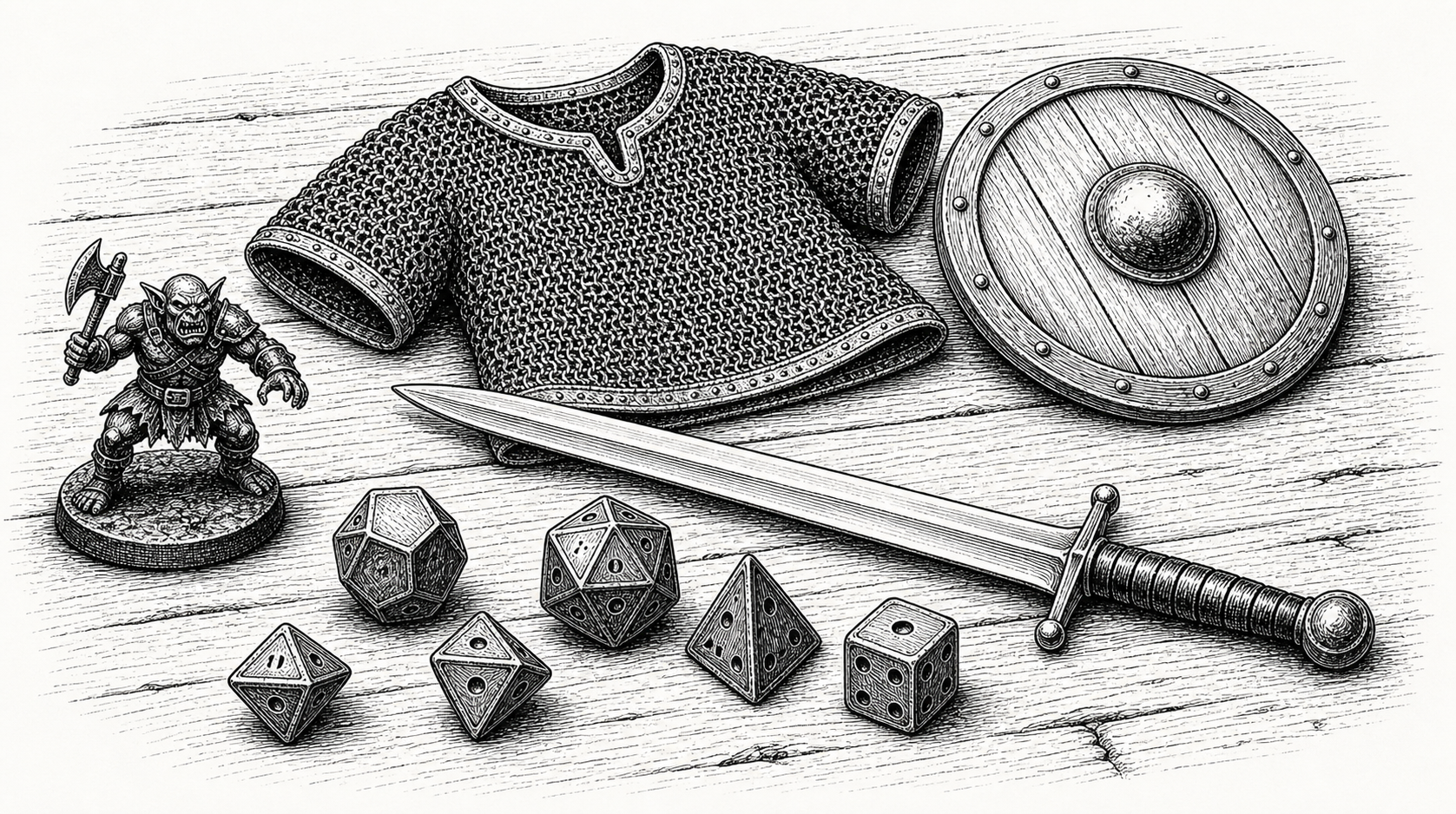
Combat is meant to be easy to explain and easy to test.
| Combat default | Value |
|---|---|
| Damage kind | physical |
| Unarmed damage | 1d3, plus STR bonus every 4 points |
| Attack cooldown | 1.0 seconds |
| Cast cooldown | 1.5 seconds |
| Global cooldown | 0.5 seconds |
| Critical roll | 20 |
| Critical multiplier | 1.5 |
Example Attack
A level 1 Human Warrior attacks an Orc with a training sword.
| Step | Result |
|---|---|
| Weapon | training_sword |
| Damage roll | 1d6 |
| Flat bonus | +1 |
| Strength bonus | STR 12, so +3 from bonus_every = 4 |
| Damage kind | physical |
| Cooldown | 1.0 seconds |
If the die rolls 4, the attack starts at 4 + 1 + 3 = 8 physical damage.
The Orc's physical reduction then comes from ARMOR and equipped armor before
the final amount is applied.
Damage Kinds
| Kind | Meaning | Reduction |
|---|---|---|
physical | mundane weapon and body damage | ARMOR plus equipped armor ARMOR |
arcane | unshaped magical force | RESIST plus equipped armor RESIST |
spell | compatibility name for arcane force | RESIST plus equipped armor RESIST |
fire | heat, flame, and burning magic | FIRE_RESIST plus equipped armor FIRE_RESIST |
Weapons
Weapons define category, slot, cooldown, damage kind, visual data, and dice damage.
| Weapon | Category | Slot | Cooldown | Damage | Visual |
|---|---|---|---|---|---|
training_sword | sword | main_hand | 1.0 | 1d6, bonus 1, STR every 4 | wooden diagonal sword mask |
hand_axe | axe | main_hand | 1.2 | 1d8, bonus 1, STR every 4 | diagonal axe mask |
novice_mace | mace | main_hand | 1.15 | 1d6, bonus 0, STR every 4 | diagonal mace mask |
hunting_bow | bow | main_hand | 1.5 | 1d6, bonus 0, DEX every 4 | diagonal bow mask |
training_spear | spear | main_hand | 1.25 | 1d6, bonus 1, STR every 4 | diagonal spear mask |
Weapon categories add shared behavior.
| Category | Hands | Base cooldown | Range |
|---|---|---|---|
| sword | one-handed | 1.0 | default melee |
| axe | one-handed | 1.2 | default melee |
| mace | one-handed | 1.15 | default melee |
| spear | two-handed | 1.25 | 2 |
| bow | two-handed | 1.5 | 6 |
These declarations are enforced. Equipping a bow or spear occupies both
main_hand and off_hand. A shield is stored in the shield equipment slot
but also occupies off_hand, so it cannot be combined with either two-handed
weapon. One-handed weapons can still be combined with a shield.
Each class's allowed_weapons and allowed_armor lists are also authoritative:
Citizen has no weapon permission; Warrior accepts every current weapon and
armor family; Cleric accepts maces with cloth, leather, chain, and shields; and
Ranger accepts bows, swords, and axes with cloth or leather. A rejected equip
attempt leaves the item where it was.
Armor And Clothing
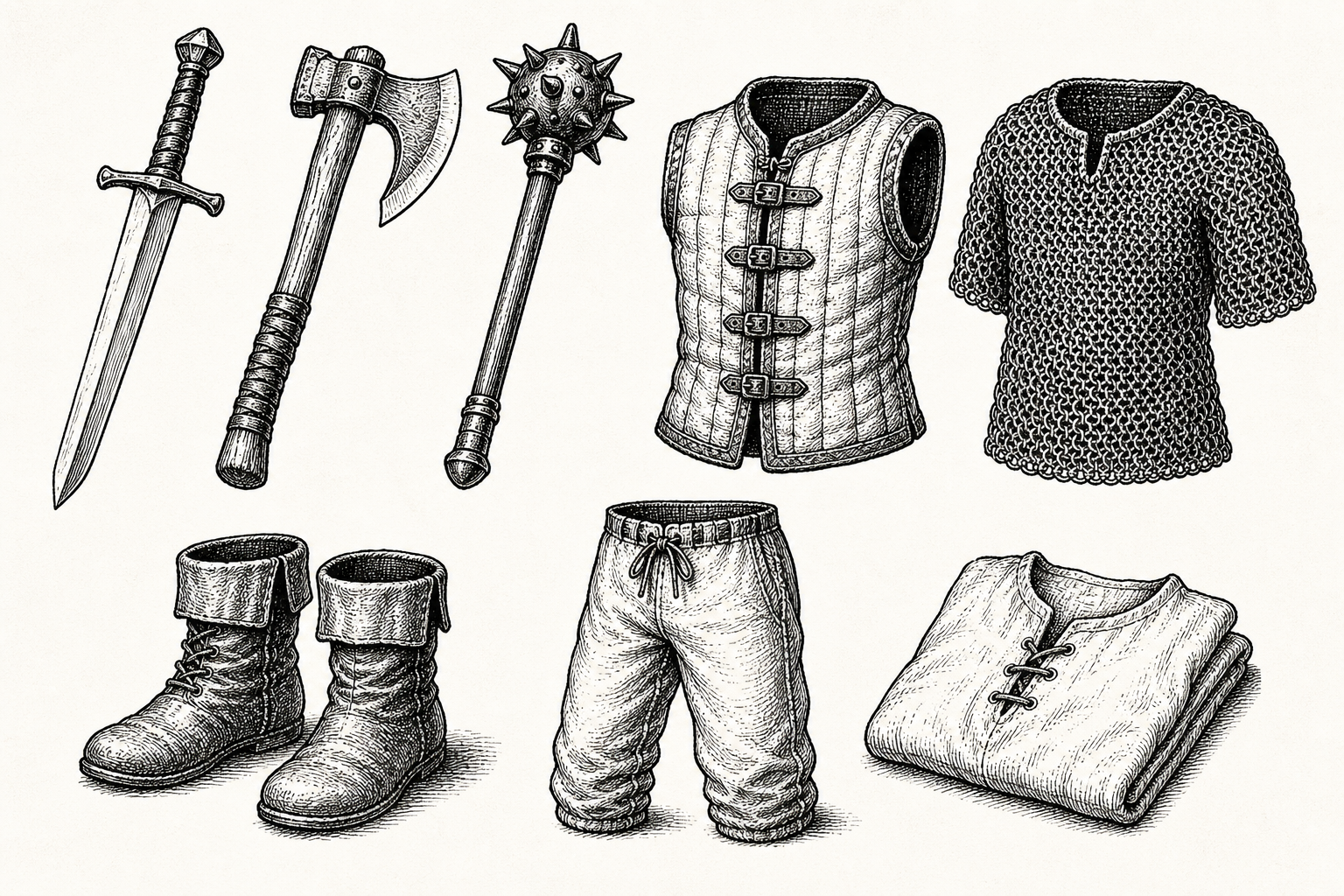
The current armor model follows broad material families: cloth, leather, chain, and shield. This keeps equipment readable and gives crafting professions a natural future path.
| Armor | Family | Slot | Armor | Avatar channels |
|---|---|---|---|---|
padded_armor | cloth | torso | 1 | torso, arms |
cleric_vestments | cloth | torso | 1 | torso, arms |
leather_vest | leather | torso | 2 | torso |
chain_shirt | chain | torso | 3 | torso, arms |
round_shield | shield | shield | 1 | round shield mask |
ritual_censer | focus | focus | POWER +1, RESIST +1 | shared mace/censer mask |
sunward_charm | focus | focus | RESIST +2, FIRE_RESIST +1 | shared charm mask |
| Clothing | Family | Slot | Worth | Avatar channels |
|---|---|---|---|---|
linen_shirt | cloth | torso | 5c | torso, arms |
wool_trousers | cloth | legs | 6c | legs |
leather_shoes | leather | feet | 8c | feet |
| Container | Family | Slots | Visual |
|---|---|---|---|
small_bag | bag | 6 | pouch mask |
loot_corpse | corpse | 8+ | tombstone mask |
Containers open as floating UI panels. They use procedural UI templates by default; a template defines columns, slot size, padding, gap, title, and palette colors. Projects can later skin the same template with tile ids for frame corners, edges, center fill, and slots without turning every bag into a custom screen.
Dead characters that call drop_items("") create a lootable corpse container
under the official rules. The corpse expands to fit the carried loot and uses
the same open, click-to-take, drag, and text transfer paths as bags. Empty
corpses despawn by default so cleaned-out tombstones do not remain on the map.
Non-empty corpses also have a lifetime. For respawning NPCs, the corpse
disappears shortly before the NPC returns, using
despawn_before_respawn_seconds; other corpses use despawn_seconds.
NPCs respawn by default. [respawn.npc] defines the delay, restores health to
full, restores the NPC's startup loadout and behavior state, and removes that
NPC's corpse when it returns. Player death is controlled by behavior nodes so games
can decide whether the player wakes at a shrine, returns to town, loses money,
keeps a tombstone, or follows another custom death loop. Individual NPCs can
override the timer with respawn_seconds or disable automatic respawn with
respawn = false.
| Ammunition | Family | Quantity | Used by | Visual |
|---|---|---|---|---|
wooden_arrows | arrow | 20 | bow, 1 per attack | diagonal arrow mask |
| Reagent | Affinity | Default stack | Used by | Visual |
|---|---|---|---|---|
blessed_herb | restoration / LO | 3 | Minor Heal, Greater Heal, ritual recipes | herb sprig mask |
moonwater | life / VI | 2 | Minor Heal, Greater Heal, Sanctuary | shared moonwater mask |
consecrated_oil | grace / YA | 2 | Holy Light, Blessing, Smite | shared holy-light mask |
warding_salt | ward / SAR | 3 | Turn Undead, Sanctuary | shared shield mask |
ember_bead | flame / FUL | 3 | Fire Spark, Smite | shared torch/ember mask |
| Material | Family | Quantity | Used by | Visual |
|---|---|---|---|---|
green_wood | wood | 5 | shafts, handles, woodworking | wood shaft mask |
feather | feather | 5 | arrow fletching | feather mask |
wild_herb | herb | 5 | gathered herbalism material | herb sprig mask |
moonleaf | herb | 4 | Moonwater distillation | recolored herb sprig mask |
sun_shard | mineral | 3 | divine oils, wards, charms | shared holy-light mask |
grave_dust | dust | 4 | Warding Salt | shared grave mask |
ember_resin | resin | 4 | Ember Beads | shared torch/ember mask |
Economy
Eldiron uses a classic copper, silver, and gold economy. All prices and rewards are stored as integer base units, where copper is the base:
| Currency | Symbol | Base value |
|---|---|---|
| Copper | c | 1 |
| Silver | s | 10 |
| Gold | g | 100 |
The UI formats base values compactly. 125 copper is shown as 1g 2s 5c.
This keeps the rules and tools simple while still presenting familiar RPG
money to players.
New player characters start with 50 copper, displayed as 5s, unless the
character explicitly defines another wealth value.
| Money item | Adds |
|---|---|
copper_coin | 1c |
silver_coin | 1s |
gold_coin | 1g |
Money items are marked monetary = true. Taking one adds its value directly to
the actor's wallet instead of placing the coin item in inventory. Normal item
worth, shop prices, loot rewards, and character wealth are all measured in
base copper units.
Money loot can use the same item template with a different value. For example,
a dropped purse can set monetary = true, currency = "silver", and
amount = 5 to add 5s when taken. worth = 50 is the equivalent raw base
value and is useful for tools and display.
Resource nodes are the world objects that produce materials. They are distinct from inventory items.
| Resource node | Action | Produces | Respawn | Visual |
|---|---|---|---|---|
wild_herb_node | gather_herbs | wild_herb x2 | 300 seconds | authored herb-sprig icon |
green_wood_node | gather_wood | green_wood x3 | 300 seconds | authored wood-shaft icon |
bird_nest_node | gather_feathers | feather x2 | 300 seconds | authored feather/nest icon |
moonleaf_patch | gather_moonleaf | moonleaf x2 | 360 seconds | authored moonleaf icon |
sunstone_outcrop | mine_sun_shards | sun_shard x2 | 480 seconds | authored golden-outcrop icon |
old_grave | sift_grave_dust | grave_dust x2 | 420 seconds | authored tombstone icon |
resinous_stump | tap_ember_resin | ember_resin x2 | 360 seconds | authored ember-resin icon |
| Tool | Worth | Interaction | State | Visual |
|---|---|---|---|---|
torch | 1s | use toggles it on/off | active automatically selects the reconstructed world tile and icon state; the script swaps the light and look text, while durability destroys the torch at 0% | one-frame Off and four-frame On PNG state bundle |
Bows consume one matching ammunition item from the attacker's inventory when a
weapon attack resolves. hunting_bow declares ammunition = "wooden_arrows"
and ammunition_quantity = 1, so the ruleset owns both which item is needed
and how many are spent. Stackable ammunition decrements its quantity; when the
stack reaches zero the inventory slot is emptied. wooden_arrows therefore
means one inventory stack of arrows, not one single arrow item per slot.
When authored item PNGs are unavailable, an item with avatar_channels can
derive a missing-art preview from the bundled humanoid avatar. This generator
is a fallback; official item-id PNGs normally provide inventory and equipment
art without runtime palette remapping.
Some official items are interactive templates rather than passive gear. A torch
contains its own script, authored state text, light definition, and lit/unlit
visual state. Its one-frame Off and four-frame On PNGs are bundled under
assets/icons/torch/; Eldiron reconstructs the world tiles from those same
files while preserving stable tile UUIDs. The generic active state mapping
selects those tiles, so the script does not contain their IDs. Projects can
therefore place a complete working torch without maintaining separate icon and
tile binaries. Its burn time is rules-owned through [durability]: while
active, it drains condition by 10% per 60 game minutes, and on_empty = "destroy" removes the burned-out torch.
Abilities And Spells
Abilities and spells define what exists. Actions define how an actor performs a gameplay verb. This keeps the current RPG layer compatible with future sandbox verbs such as harvesting, crafting, lockpicking, stealing, or taming.
Spellbook
Words of Power are listed directly beside their spells. They are an optional input vocabulary: a graphical game may show spell icons, a text game may accept the words, and a rune-based game may draw the same tokens as symbols.
| Spell | Words of Power | MP | Reagents | Effect |
|---|---|---|---|---|
| Minor Heal | LO VI | 3 | Blessed Herb x1, Moonwater x1 | restore 1d6 + 1, scaling with WIS |
| Holy Light | YA FUL | 4 | Consecrated Oil x1 | deal 1d6 + 1 arcane damage, scaling with WIS |
| Blessing | YA | 5 | Consecrated Oil x1 | grant divine power and resistance |
| Turn Undead | SAR IR | 5 | Warding Salt x1 | weaken and repel an undead target |
| Greater Heal | LO LO | 7 | Blessed Herb x2, Moonwater x1 | restore 2d6 + 3, scaling with WIS |
| Smite | FUL YA | 6 | Consecrated Oil x1, Ember Bead x1 | deal 2d6 + 2 arcane damage, scaling with WIS |
| Sanctuary | SAR VI | 9 | Warding Salt x1, Moonwater x1 | grant strong physical and magical protection |
| Fire Spark | FUL | 2 | Ember Bead x1 | deal 1d6 fire damage, scaling with INT |
The six-word lexicon is intentionally small:
| Word | Meaning | Material affinity |
|---|---|---|
LO | restore | herbs |
VI | life | moonleaf and Moonwater |
FUL | flame | Ember Resin and Ember Beads |
YA | grace | Sun Shards and Consecrated Oil |
IR | banish | graves and the dead |
SAR | ward | Warding Salt |
The ingredients echo the spoken construction without enforcing a mechanical one-token/one-item rule. That keeps each spell memorable while leaving room for recipes, substitutions, reagent-free settings, or entirely different input schemes in custom games.
| Action | Kind | Target | Cost | Result |
|---|---|---|---|---|
basic_attack | attack | hostile or neutral entity | - | weapon damage |
power_strike | attack | hostile or neutral entity | - | power_strike damage |
guard | stance | self | - | apply guarded for 2.0s |
rally | stance | self | - | apply rallied for 6.0s |
crushing_blow | attack | hostile or neutral entity | - | crushing_blow damage |
iron_guard | stance | self | - | apply iron_guarded for 5.0s |
executioner_strike | attack | hostile or neutral entity | - | executioner_strike damage |
aimed_shot | attack | hostile or neutral entity | - | aimed_shot damage |
quick_step | stance | self | - | apply quick_step for 4.0s |
piercing_shot | attack | hostile or neutral entity | - | piercing_shot damage |
hunter_focus | stance | self | - | apply hunter_focus for 6.0s |
deadly_shot | attack | hostile or neutral entity | - | deadly_shot damage |
minor_heal | spell | friendly or self | 3 MP, Blessed Herb, Moonwater | minor_heal healing |
holy_light | spell | hostile or neutral entity | 4 MP, Consecrated Oil | holy_light damage |
blessing | spell | friendly or self | 5 MP, Consecrated Oil | apply blessed for 8.0s |
turn_undead | spell | hostile or neutral undead entity | 5 MP, Warding Salt | apply turned for 5.0s |
greater_heal | spell | friendly or self | 7 MP, Blessed Herb x2, Moonwater | greater_heal healing |
smite | spell | hostile or neutral entity | 6 MP, Consecrated Oil, Ember Bead | smite damage |
sanctuary | spell | friendly or self | 9 MP, Warding Salt, Moonwater | apply sanctuary for 8.0s |
fire_spark | spell | hostile or neutral entity | 2 MP, Ember Bead | fire_spark damage |
take | interaction | ground item | - | move item to inventory |
gather_herbs | gather | resource node | - | resource output |
gather_wood | gather | resource node | - | resource output |
gather_feathers | gather | resource node | - | resource output |
gather_moonleaf | gather | resource node | herbalism 5 | moonleaf x2 |
mine_sun_shards | gather | resource node | ritualism 5 | sun_shard x2 |
sift_grave_dust | gather | resource node | ritualism 10 | grave_dust x2 |
tap_ember_resin | gather | resource node | alchemy 5 | ember_resin x2 |
craft_blessed_herb | craft | self | 1 wild_herb, minor_heal known | blessed_herb x1 |
craft_wooden_arrows | craft | self | 1 green_wood, 2 feather | wooden_arrows x10 |
craft_hunting_bow | craft | self | 3 green_wood, recommended fletching 25 | hunting_bow x1 |
The optional words_of_power scheme binds the sequences in the Spellbook to
ordinary actions. This is an input method, not separate spell logic: knowledge,
targeting, costs, cooldowns, effects, and FX still come from the same action. A
game can render the tokens as words, runes, icons, or buttons, or ignore the
scheme. A Messages command input accepts the phrases directly, including a
named target when needed: LO VI, SAR IR at skeleton, or the explicit
invoke words_of_power:YA FUL at orc form.
Action definitions already include a generic consumes list, so spells,
crafting, and other sandbox actions can require reagents or materials without a
new hardcoded system. These costs use stack quantities too: consuming three
arrows, herbs, ore, or reagents subtracts three from a matching stack before it
removes an inventory slot.
Actions can also declare skill and required_skill. The first gather actions
are open at required_skill = 0, but the same mechanism is now available for
higher-tier ore, wood, herbs, locks, traps, and profession actions.
Standalone and heavily customized games can gate an action on their own actor
attributes through requires.attributes. Predicates support scalar equality,
numeric minimum/maximum values, and membership in tag-like string lists. For
example an action can require karma >= 10, mode = "stealth", and a
traits list containing "undead" without requiring a class or level system.
requires.target_attributes applies the same vocabulary to the selected
entity, enabling actions such as Turn Undead without a Skeleton-specific
engine branch. The official level-4 Cleric action now demonstrates this: it
requires the target's ordinary traits list to contain undead, then applies
the generic turned condition. A living hostile target fails before MP,
cooldown, or particles are consumed.
Those actions can also use result.modify for built-in state changes. A single
action may add to numeric actor or target values, set numeric, boolean, or
string attributes, and clamp a result to fixed bounds or another recipient
attribute. This covers verbs such as resting, consuming stamina, changing
karma, or entering a frightened state without writing an action-specific
runtime branch.
Actions can apply or remove reusable conditions. The official guard action
applies conditions.guarded, whose definition owns its two-second duration,
refresh behavior, tags, and ARMOR +2 modifier. The server tracks remaining
time and stacks separately from base attributes, so expiration never has to
restore a previously overwritten ARMOR value. Other rulesets can use the same
path for poison, blessings, stances, or curses, including trait-based
immunities, stack-scaled periodic damage/healing/resource effects, lifecycle
events, and apply/active/tick/remove particle phases. Guard demonstrates the
visual lifecycle with a blue-white burst and an aura that follows its owner.
Turned demonstrates a harmful trait-gated condition with POWER -4, halved
SPEED, and its own divine apply/active/remove particles.
Active condition stacks, remaining time, periodic phase, and stable applying
source survive serialized region state; transient particles are rebuilt rather
than treated as saved gameplay objects.
The three adventuring action bars expose their full level-10 path. Locked buttons use the same class unlock data to report the required level.
classes.<id>.unlocks.level_N is the sole owner of when an ability or spell is
known. Starting loadouts own items only. Ability and spell definitions own
identity and roll data; actions own targets, costs, cooldowns, results, and FX.
Scripts use attack() for the normal weapon attack. Named action buttons or
text commands use use_action("<id>"); for example use_action("power_strike")
or use power strike orc in text play. A custom source-tool action may use
use_action(action_id, target_id, source_item_id) to select the exact owned
tool instance. Resource actions can also be typed by name, such as gather herbs, gather wood, or gather feathers, which targets the nearest matching
visible resource node. Successful gathering sends a localized result message
such as You gather Wild Herb x2. Recipes can be
typed by name too, such as craft blessed herb, craft wooden arrows, or
craft hunting bow. Container transfers start with simple text commands such
as open small bag, put wild herb in bag, and take wild herb from bag.
| Ability | Kind | Cooldown | Range | Effect |
|---|---|---|---|---|
basic_attack | attack | 1.0 | weapon | normal physical attack |
guard | stance | 3.0 | self | ARMOR +2 for 2.0 seconds |
power_strike | attack | 4.0 | weapon | 1d8, bonus 2, STR every 4 |
rally | stance | 10.0 | self | DMG +2, RESIST +1 for 6.0 seconds |
crushing_blow | attack | 6.0 | weapon | 1d10, bonus 3, STR every 4 |
iron_guard | stance | 12.0 | self | ARMOR +4, reduced speed for 5.0 seconds |
executioner_strike | attack | 8.0 | weapon | 2d8, bonus 4, STR every 3 |
aimed_shot | attack | 4.0 | weapon | 1d8, bonus 2, DEX every 4 |
quick_step | stance | 9.0 | self | SPEED +1, ARMOR +1 for 4.0 seconds |
piercing_shot | attack | 6.0 | weapon | 1d10, bonus 3, DEX every 4 |
hunter_focus | stance | 10.0 | self | DMG +2, INIT +2 for 6.0 seconds |
deadly_shot | attack | 8.0 | weapon | 2d6, bonus 4, DEX every 3 |
| Spell | Words of Power | School | Kind | Cost | Cooldown | Range | Roll |
|---|---|---|---|---|---|---|---|
minor_heal | LO VI | restoration | heal | 3 MP, 1 blessed_herb | 4.0 | 5 | 1d6, bonus 1, WIS every 4 |
holy_light | YA FUL | restoration | damage | 4 MP | 5.0 | 5 | 1d6, bonus 1, WIS every 4 |
blessing | YA | restoration | support | 5 MP | 8.0 | 5 | POWER +2, RESIST +2 for 8.0s |
turn_undead | SAR IR | divine | control | 5 MP | 10.0 | 5 | undead target only; POWER -4, SPEED ×0.5 for 5.0s |
greater_heal | LO LO | restoration | heal | 7 MP, 1 blessed_herb | 7.0 | 5 | 2d6, bonus 3, WIS every 4 |
smite | FUL YA | divine | damage | 6 MP | 7.0 | 6 | 2d6, bonus 2, WIS every 4 |
sanctuary | SAR VI | restoration | support | 9 MP | 12.0 | 5 | ARMOR +3, RESIST +4 for 8.0s |
fire_spark | FUL | fire | damage | 2 MP | 3.0 | 6 | 1d6, bonus 0, INT every 4 |
Spell FX reference particle preset branches under /fx/presets. Their particle
nodes describe the emitter directly, with an animated preview in Creator.
Explicit action stages override the official semantic fallbacks. Attacks use
hit_burst for an otherwise unspecified impact; healing uses rising_motes;
condition actions use holy_glow while casting; and conditions share
apply/active/tick/remove defaults. A different ruleset may replace or omit
these mappings without engine changes.
| Spell | Cast FX | Travel FX | Impact FX |
|---|---|---|---|
minor_heal | rising_motes | - | rising_motes |
holy_light | holy_glow | holy_bolt | hit_burst |
fire_spark | - | ember_trail | fire_burst |
| FX Preset | Description |
|---|---|
hit_burst | short impact burst from the target center |
rising_motes | soft particles across the tile, moving upward |
holy_glow | warm divine aura around caster or target |
holy_bolt | focused holy projectile with trailing glow |
fire_burst | hot impact explosion with sparks and smoke |
flame_patch | small burning area on the tile |
ember_trail | embers behind a moving fire spell |
Progression
Progression uses explicit tables so balancing is visible.
| Level | Required XP |
|---|---|
| 2 | 100 |
| 3 | 250 |
| 4 | 450 |
| 5 | 700 |
| 10 | 2700 |
Minor quests award 25 XP, major quests award 100 XP, and kill XP starts at
25 per defender level.
The current maximum level is 10. Adventuring classes gain their core kit at
level 1 and new actions at levels 2, 4, 6, 8, and 10; odd levels still improve
class resources and primary attributes. Extending the same rules to level 30
only requires additional XP rows and unlocks.level_N tables—no representation
or runtime branch change. The runtime treats max_level as authoritative for
both explicit XP tables and the optional xp_for_level formula form.
Visual Defaults
Rules and visuals meet in play, so the ruleset provides a consistent default visual layer.
| Visual rule | Value |
|---|---|
| Default avatar | humanoid |
| Avatar assets | assets/humanoid.eldiron_avatar, assets/orc.eldiron_avatar, assets/skeleton.eldiron_avatar |
| Ruleset Palette | fixed rules-owned mood palette based on Lospec's "31" palette |
| Explicit override | project tile_id, avatar, or empty visual fields win |
On load, Eldiron resolves the effective ruleset palette into the project's Ruleset Palette. This keeps avatar channels, UI color defaults, and generated missing-art fallbacks on stable rules-owned indices. Authored icon PNGs retain their own RGBA colors and are not palette-remapped at runtime.
The editable Art Palette remains separate for tiles, drawing, palette-index geometry sources, and 3D Paint.
Tools And Testing
The official ruleset is structured so tools can answer practical authoring questions without guessing:
- Which items does a level 1 Warrior start with?
- Can a Cleric equip this weapon?
- What is the attack range of this weapon?
- How much XP is needed for the next level?
- What damage can this weapon or spell roll?
- Which race relation makes this target hostile?
- How long until this character can attack again?
- What happens if this Orc fights this Warrior 100 times?
The same node-compiled rules serve gameplay, Creator UI, terminal tools, console tools, validation, and automated arena tests.
Work In Progress Roadmap
The current draft is a playable slice, not the final v1 promise.
Already present or underway:
- Human and Orc race baselines
- Warrior and Cleric class baselines
- default race relations and reputation thresholds
- attack, take, and use intent rules
- weapon and unarmed dice damage
- physical, arcane, spell, and fire damage kinds
- cloth, leather, chain, and shield armor families
- starter weapons, armor, clothing, abilities, and spells
- default humanoid avatar and rules-owned palette
- stackable materials, reagents, ammunition, and first crafting recipes
- skill-gated crafting with open profession growth
- first item container,
small_bag, with text transfer commands - Creator integration and rules-aware tools
Expected v1 growth areas:
- more playable classes and enemy roles
- more races and creature templates
- a larger spell and ability catalogue
- larger crafting professions, reagents, recipes, stations, and item outputs
- container popups, bags, chests, corpses, and loot transfer UI
- loot tables and treasure rules
- more conditions such as stunned, burning, poisoned, and blessed, using the existing periodic-effect, lifecycle-event, immunity, and particle vocabulary
- armor proficiency, weapon proficiency, and class restrictions
- encounter templates and automatic arena balance tests
- rarity, value, repair rules, and deeper quality/condition effects
- richer AI intent rules and disposition changes
- localization-ready rule names, messages, and descriptions
- illustrated guide pages and deeper examples
The long-term goal is not a tiny ruleset. The goal is a real world simulation that starts simple, stays readable, and grows without returning to scattered per-character configuration.